A Life in Songs: Hold Me Now (1983)
A Life In Songs
An occasional series about some of the songs I love, and the impact they might have had on politics, sport and culture in the UK in the year they were released.
How a Thompson Twins ballad became the soundtrack to a nation caught between Thatcher, cricket, and the cold war.
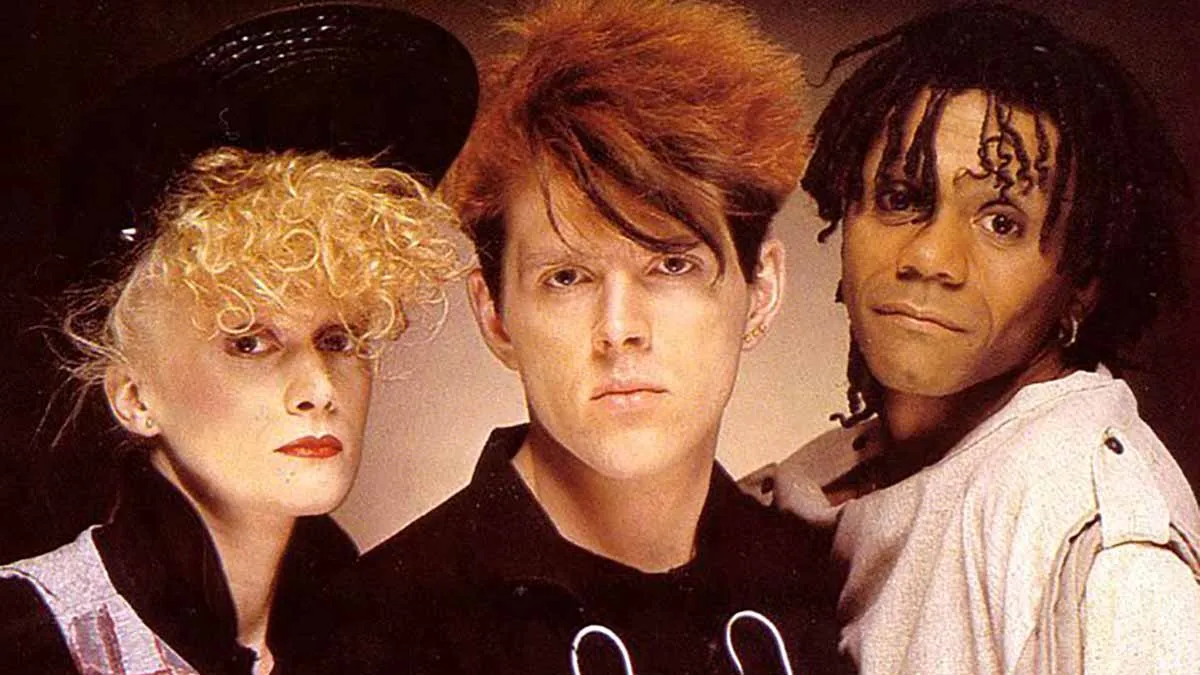
In the dying weeks of 1983, a song crept up the British charts that seemed, on the surface, to be nothing more than a synth-pop love ballad. Tom Bailey's plaintive vocal — "Hold me now, warm my heart, stay with me, let loving start" — floated over shimmering Fairlight chords and a drum machine that ticked like a clock counting down to something nobody quite understood. The Thompson Twins had delivered their masterpiece, and Britain barely had time to notice. It was too busy arguing about everything else.
I. The Iron Lady's Second Act
By the time "Hold Me Now" reached the airwaves, Margaret Thatcher had already secured her crushing general election victory in June. The Conservatives won 397 seats — a landslide built on the afterglow of the Falklands War and the fractured opposition of Michael Foot's Labour Party, which had presented what Gerald Kaufman famously called "the longest suicide note in history" as its manifesto.
The country Bailey was singing to was one of stark contradictions. Unemployment had climbed above three million for the first time since the 1930s. The miners, led by Arthur Scargill, were on the cusp of a confrontation that would define the decade. And yet, in the shopping centres of Middle England, the new consumer culture was taking hold — compact disc players were arriving in the shops, and the first mobile phone call in the UK was still a year away.
"Both of us searching for some perfect world we know we'll never find." The vulnerability in those lyrics felt almost subversive in a year when the national mood was supposed to be one of triumphant certainty.
II. Wickets, Goals & Frozen Pitches
If "Hold Me Now" was a plea for human warmth, British sport in 1983 could have used some too. The year belonged, above all, to cricket. In the summer, India, rank outsiders captained by the mercurial Kapil Dev →stunned the West Indies in the World Cup final at Lord's. The English, who had invented the tournament, were left to watch as someone else's party unfolded on their own lawn.
English football, meanwhile, was mired in its own malaise. Liverpool won the First Division title — their fourteenth — playing a brand of football that was ruthlessly effective if not always beautiful. Hooliganism was a constant shadow. The terraces were crumbling. The game's transformation into the polished Premier League spectacle was a full decade away. The FA Cup final saw Manchester United beat Brighton 4-0 in a replay, after a chaotic 2-2 draw in which Brighton's Gordon Smith had the chance to win it and somehow didn't. → "And Smith must score!" — the commentator's cry became one of those phrases that haunts a man forever.
While English terraces were crumbling, Scottish football was experiencing a golden age. 1983 was the year of the "New Firm." In May, Dundee United—led by the legendary Jim McLean—stunned the country by clinching their first-ever top-flight league title, winning it on the final day in a tense derby against local rivals Dundee.
But the real seismic shift happened in Europe. Just ten days before that Scottish league climax, Alex Ferguson’s Aberdeen achieved the unthinkable. In the pouring rain of Gothenburg, a team of local lads defeated the mighty Real Madrid 2-1 to lift the European Cup Winners' Cup. When John Hewitt’s header hit the net in extra time, it wasn't just a win for the Granite City; it was a signal that the tactical genius of a young Ferguson had arrived on the world stage.
By the time the Thompson Twins were climbing the charts in late '83, Aberdeen had added the → European Super Cup to their trophy cabinet, beating Hamburg to become, arguably, the best club side in the world. In a year of Cold War dread and economic hardship, these "unfancied rural sides" provided a masterclass in defiance that mirrored the grit of the era.
Meanwhile on the turntable
The Thompson Twins' album Into the Gap — which housed "Hold Me Now" — would go on to sell six million copies worldwide. Tom Bailey, Alannah Currie, and Joe Leeway had trimmed the band from its earlier, unwieldy seven-piece incarnation into a sleek pop trio. The song's structure was deceptively simple: verse, chorus, bridge, but underpinned by a sophistication that set it apart from the more disposable synth-pop of the era.
In rugby, England's Five Nations campaign was middling at best — finishing third behind France and Ireland. But the sport was amateur in those days, played by men who had day jobs as solicitors and farmers. The idea that rugby players might one day earn millions was as fanciful as the notion that the Thompson Twins might outlast Duran Duran. (Neither prediction came true, though rugby got closer.)
British culture in 1983 was a glorious mess. On television, → Blackadder debuted on BBC One — though the first series, set in the medieval era, was widely considered a dud. It would take a second series and a move to Elizabethan England before Rowan Atkinson and Ben Elton found the formula that made it legendary. → Auf Wiedersehen, Pet premiered too, capturing the reality of British workers seeking employment in Germany — a plotline that spoke directly to the unemployment crisis.
At the cinema, the year belonged to → Educating Rita and → Local Hero — two films that, like "Hold Me Now," dealt in the quiet drama of people trying to connect. Michael Caine's dissipated English professor and Julie Walters' irrepressible Open University student gave British cinema its warmest double act in years, whilst Bill Forsyth's gentle Scottish fable about an American oil company trying to buy a Highland village became a cult classic.
The charts were a battlefield. Culture Club were at their imperial peak — "Karma Chameleon" was the year's biggest seller. Duran Duran were filling arenas. Eurythmics had broken through with "Sweet Dreams." Spandau Ballet's "True" dripped with aspirational romance. And there, nestled amongst the shoulder pads and the eyeliner, was "Hold Me Now" — less flamboyant than its rivals, but possessed of an emotional directness that made it stick.
III. Cruise Missiles & Greenham Common
Beneath the pop music and the football, 1983 was a year of genuine existential dread. In November — the very month "Hold Me Now" was climbing the charts — NATO conducted Able Archer 83, a military exercise so realistic that Soviet leadership genuinely feared it was cover for a first nuclear strike. The world came closer to annihilation than most people realised at the time. Declassified documents would later reveal just how close the trigger finger had hovered.
At → Greenham Common in Berkshire, the women's peace camp — established in 1981 to protest the deployment of American cruise missiles on British soil — had become the defining image of grassroots resistance. On the 12th of December, some 50,000 women linked arms and encircled the base. It was an act of extraordinary collective defiance, conducted in the freezing English winter, whilst the radio played songs about wanting to be held.
"You say I'm a dreamer — we're two of a kind." In a year when dreaming felt like the only sane response to the possibility of nuclear war, those words carried weight that Bailey perhaps never intended.
V. What Remains
"Hold Me Now" peaked at number four in the UK charts. It didn't quite reach the summit, denied by the juggernaut of "Only You" by the Flying Pickets — an a cappella cover of the Yazoo original, performed by a group of actors with socialist leanings. Even the Christmas charts were political in 1983. "Uptown Girl", by Billy Joel, and Paul Young's "Love of The Common People" further blocked the road to the top as we headed for 1984.
The Thompson Twins would never quite recapture the magic. Into the Gap was their commercial zenith, and the law of diminishing returns set in thereafter. Tom Bailey retreated from public life for years. Alannah Currie turned to art. Joe Leeway disappeared almost entirely from the music world.
But the song endures. It endures because it captured something true about the human condition in 1983 — a year when Britain was simultaneously triumphant and terrified, when the bombs were ninety miles away and the dole queue stretched around the block, when a nation that had just fought a war in the South Atlantic was asking its own people to accept that there was no alternative to mass unemployment.
"Hold me now" wasn't just a love song. It was what everyone was thinking but nobody in power was prepared to say. It was, and remains, a quiet act of tenderness in a year that badly needed one.